PA (nylon)
Best all-round balance: flexible, abrasion resistant, approx. −40 to 120 °C continuous. For cabinets, automotive branch harnesses and internal equipment routing.
SPIRAL WRAP
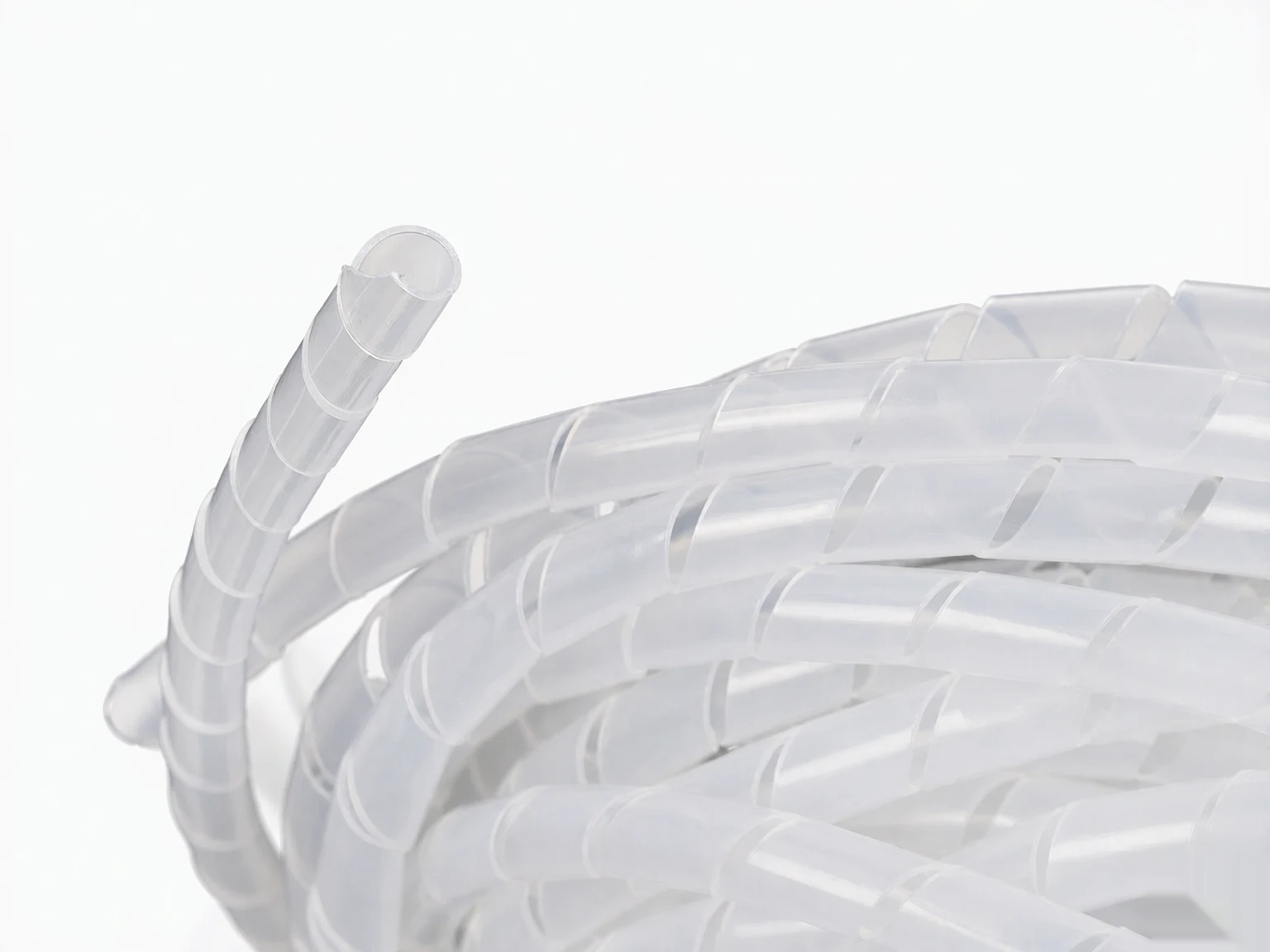
Spiral-cut protective tubing wound around the outside of a harness. Compared with braided and self-wrapping sleeving, spiral wrap can be added and removed locally — no threading from the end, no disconnection — which suits branch points, service sections and local reinforcement. Three materials, chosen by temperature and chemical exposure.
Materials
Best all-round balance: flexible, abrasion resistant, approx. −40 to 120 °C continuous. For cabinets, automotive branch harnesses and internal equipment routing.
Strongest temperature and chemical resistance, lowest friction, up to 260 °C. For high-temperature sections, chemical environments and sensor leads.
Softest and good temperature resistance, up to 200 °C. For positions where wire insulation must not be pinched and where a soft transition is needed.
Selection
All three materials are supplied white as standard; other colours are customised to order, subject to MOQ and lead time. Spiral wrap provides no sealing or flame-retardant guarantee — confirm the material grade separately where flame performance is required.
Material comparison
Temperature values are reference ranges; the datasheet governs.
| Material | Continuous temp. (reference) | Flexibility | Abrasion | Chemical resistance | Typical use |
|---|---|---|---|---|---|
| PA (nylon) | −40 to 120 °C | Good | High | Moderate | Cabinets, automotive branches, equipment internals |
| PTFE | To 260 °C | Medium (stiffer) | Medium | Very high | High-temperature sections, chemicals, sensor leads |
| Silicone | To 200 °C | Best | Low | Good | Pinch-sensitive positions, soft transitions |
Spiral wrap does not provide sealing or a flame-retardant guarantee; confirm the material grade for flame requirements.
Consolidate colours to 2–3 references per project — small quantities in many colours lengthen lead time considerably.
Trade-off
Self-wrapping closes over a whole section with continuous coverage; spiral wrap starts and stops anywhere. The first suits full-length protection, the second local reinforcement and branch points. Both can be added without disconnecting the harness and are often combined on one harness.
Spiral wrap is an open structure with no sealing against liquids or dust — use closed sleeving or heat shrink where sealing is required.
Installation pitfalls
Wind along the harness direction; reversed winding loosens under bending. Close towards the branch at junctions.
Stretching pitch to twice the band width leaves under 50% coverage and defeats the abrasion protection. 30–50% overlap is the normal range.
Both ends need a tie or heat-shrink termination, otherwise the wrap migrates axially and collects in one place.
It is an open structure: no protection against liquids or dust, and no dielectric guarantee.
FAQ
Self-wrapping closes continuously over a whole section; spiral wrap has a spiral cut and can start or stop anywhere. Use the first for full-length protection, the second for local reinforcement and branches.
PA is limited to about 120 °C; move to PTFE (to 260 °C) or silicone (to 200 °C) near heat sources.
Yes — the spiral cut makes cutting easy. Cut ends are open, so terminate with a tie to avoid abrasion.
All three materials are white as standard; other colours are customised, subject to minimum order quantity and lead time.
RFQ
Diameter after wrapping, band width and pitch determine quantity and coverage:
Related products
Samples and selection
Include diameter after wrapping, length, temperature and chemical exposure, colour, cut length and expected volume.